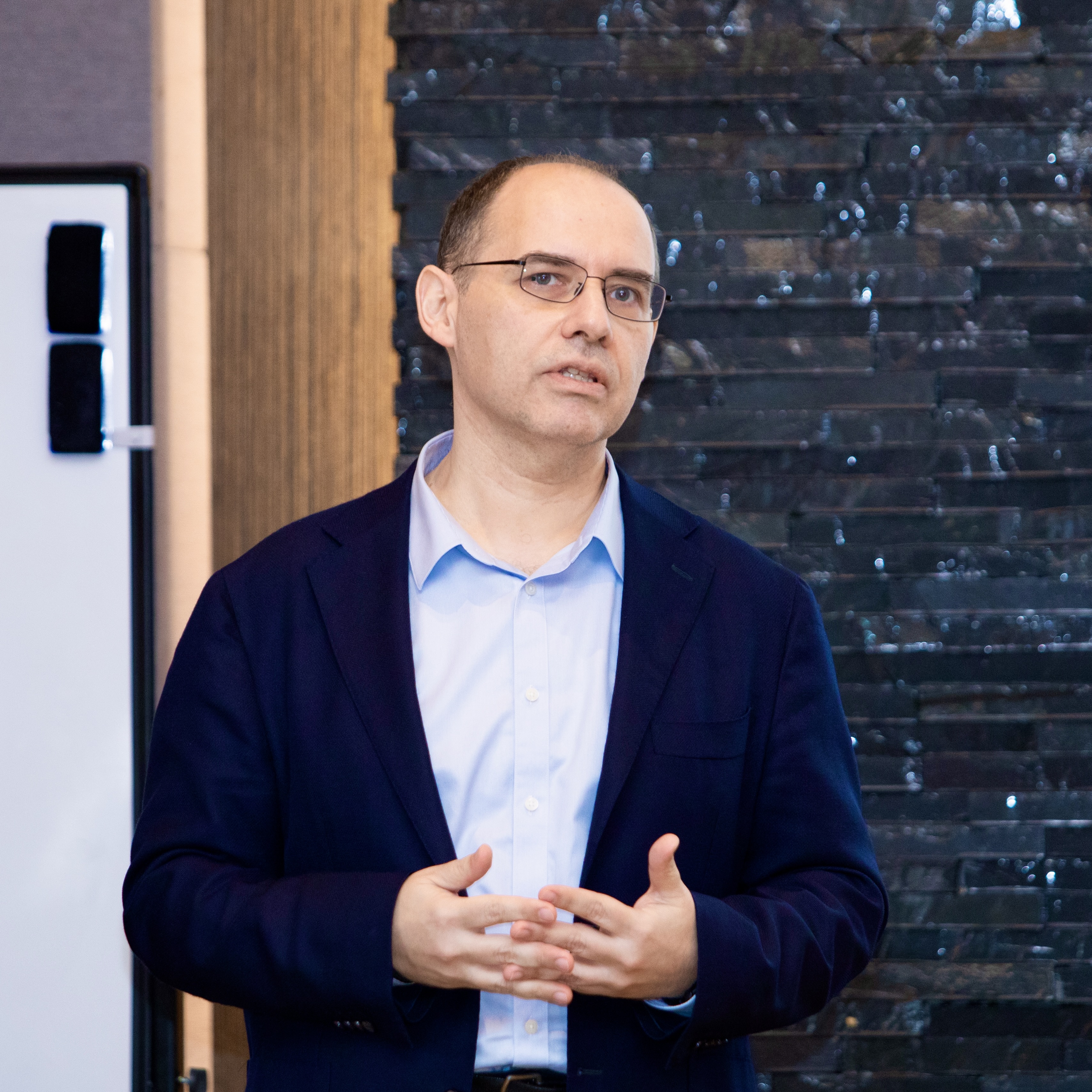
Konstantinos Efstathiou
Associate Professor of Mathematics
Associate Dean of Undergraduate Curricular Affairs
Duke Kunshan University
Konstantinos Efstathiou is Associate Professor of Mathematics at Duke Kunshan University.
His research interests in dynamical systems include the geometrical and topological aspects of integrable Hamiltonian systems and the collective dynamics of coupled oscillators.
Recent Posts
During the week of July 13–17, I am participating in the workshop Geometric Structures and Differential Equations — Symmetry, Singularity, and Applications, held at the Research Institute of Mathematical Sciences of Kyoto University. At the workshop, I present recent work on the Tavis–Cummings system with an $A_2$ singularity. I am grateful to Daisuke Tarama and the other organizers for the invitation to present my work and for putting together an exciting program.
I am visiting the University of Antwerp to serve as a member of the PhD defense committee for Pedro Santos. In connection with the defense, Pedro Santos and Sonja Hohloch are organizing a mini-workshop on Invariants and Integrable Systems. As part of the workshop, I presented recent work on the Tavis–Cummings system with an $A_2$ singularity.