Journal
I will be presenting a talk on Fractional Hamiltonian monodromy at the XXVth International Conference on Integrable Systems and Quantum symmetries (ISQS-25), which takes place in Prague from 6 to 10 June 2017. The talk is part of the special session on Spectral Asymptotics of Quantum Integrable Systems that is being organized by John Toth, San Vũ Ngọc, and Steve Zelditch.
Pulse coupled oscillator networks with delay are a source of interesting dynamics, for example, unstable attractors. In recent work with Pan Li and Wei Lin we found that such networks exhibit isochronous regions―subsets of the phase space filled with periodic orbits having the same period. We studied such isochronous regions both analytically and numerically, giving a proof of their existence and a detailed description of their properties.
Details can be found in our paper which has been published in Chaos and is also available from the arXiv.
Together with Andrea Giacobbe and Tudor Ratiu we are organizing a special session on Geometry and Dynamics at the 12th AIMS Conference on Dynamical Systems, Differential Equations and Applications (AIMS 2018) which takes place in Taipei, Taiwan from 5 to 9 July 2018.
On 2 December 2016 I give a talk on Fractional Hamiltonian Monodromy and Circle Actions at the GQT colloquium. The organizers of the GQT school and colloquium are Raf Bocklandt, Gil Cavalcanti, and Maarten Solleveld.
Several years ago I had written here about a Mathematica implementation of the algorithm for computing normal forms for Hamiltonian systems. That post was written for people who are already familiar how the algorithm works and could figure out what functions like rangePart are inverseAd are doing. To make that implementation more accessible I give here an example of how to use it to compute the normal form for the Hénon-Heiles Hamiltonian given by
On 19 October 2016 I give a talk on Fractional Hamiltonian Monodromy and Circle Actions at the Symposium on advances in semi-classical methods in mathematics and physics. The symposium takes place in Groningen to honor H. J. Groenewold’s seminal 1946 paper On the principles of elementary quantum mechanics and the 70 years since its publication.
In this work, together with Nikolay Martynchuk, we investigated fractional monodromy in two-degree of freedom integrable Hamiltonian systems. In such systems, Seifert manifolds naturally appear by taking closed paths in the image of the integral map and considering the preimage of such paths in the phase space. Fractional monodromy is then defined through the parallel transport of homology cycles along Seifert manifolds, expanding on an idea from Uncovering fractional monodromy. It turns out that fractional monodromy is determined by the exceptional fibers of the Seifert manifold and by the fixed points of the circle action. This result, in the same spirit as results for monodromy of torus bundles, provides a deep understanding of fractional monodromy and its origins. This is the first time that fractional monodromy has been associated to a certain type of singularities in integrable Hamiltonian systems (fixed points of a circle action). Details can be found in our paper which is now on the arXiv.
I first learned how to compute monodromy of torus bundles in integrable Hamiltonian systems from Cushman’s and Bates’s “Global Aspects of Classical Integrable Systems”, now at its second edition. The computation of monodromy there effectively boils down to the computation of the variation of the rotation number along properly chosen closed paths in the system.
Recently, together with Andrea Giacobbe, Pavao Mardešić, and Dominique Sugny we needed to better understand this computation. Studying the problem led us to a much better appreciation of the subtleties involved and revealed the deep connection between this analytical computation and the geometry of the fibration.
I am giving a presentation on “Pulse Coupled Oscillator Networks” at the 7th Shanghai International Symposium on Nonlinear Sciences and Applications that takes place in Shanghai and Hunan between 13-19 July 2016.
I am giving an invited presentation on the “Bifurcations and Geometry in 1:1:-2 Resonant Hamiltonian Systems” at the conference Computational perturbative methods for Hamiltonian systems that takes place in Athens between 11-13 July 2016.

I gave an invited talk on “Generalized Hamiltonian Monodromy and Circle Actions” at the conference on Integrable Hamiltonian Systems that took place in Ascona from 19 to 24 June 2016. The conference was organized by Anton Alekseev, Sonja Hohloch, and Tudor Ratiu.
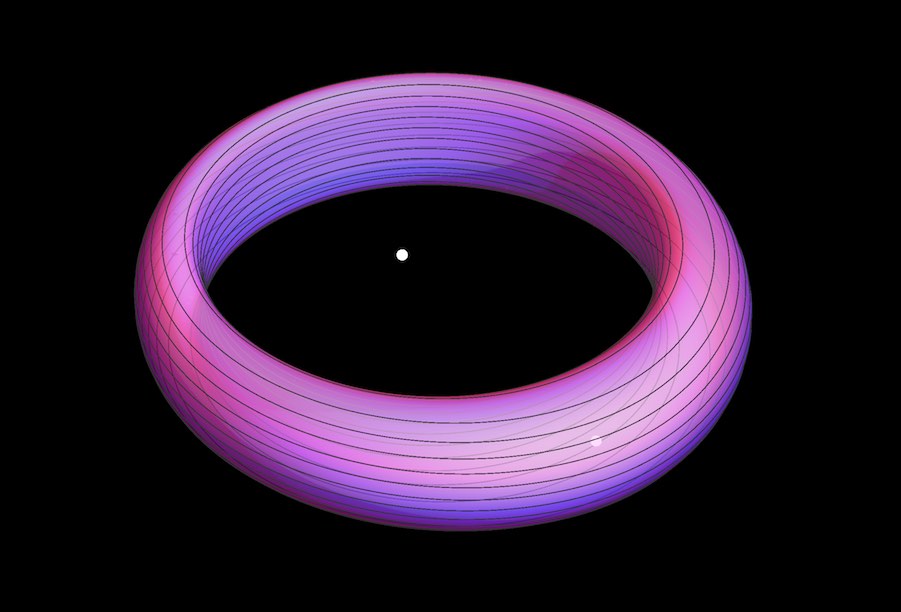
Monodromy in Hamiltonian systems has been traditionally associated to singularities of the integrable Hamiltonian fibration and, in particular, to singularities of focus-focus type. In a recent work with Nikolay Martynchuk, we showed that in 2 degree of freedom Hamiltonian systems with a circle action, to understand monodromy, one should look at the fixed point of the circle action. This result follows from the fact that, in such systems, a 2-torus bundle $E$ over a circle $\Gamma$ can be also viewed as a principal circle bundle over a 2-torus $B$. Then the monodromy of the former bundle equals the Chern number of the latter.